Democratic Clean-Tech Leaders Mike Levin and Sean Casten Oppose BAAJA

Posted by Brad Johnson on 11/23/2026 at 05:28PM

Reps. Mike Levin (D-Calif.) and Sean Casten (D-Ill.), both clean-tech businessmen before joining the House of Representatives, announced their rejection of the industrial-expediting bill known as BAAJA today.

Levin and Casten are two of the five vice chairs of the House Sustainable Energy and Environment Coalition, a large Democratic caucus focused on climate and energy policy. The office of fellow vice chair Don Beyer (D-Va.) also confirmed today that Beyer opposes BAAJA, as did the office of SEEC co-chair Paul Tonko (D-N.Y.).

Rep. Levin:

“I can’t support the energy permitting bill the Senate just sent to the House, known as BAAJA, at least not as it’s written today. Here’s why:

“I’ve spent my career as a clean energy advocate and an environmental attorney. I want us to build clean energy, and to build it far faster than we do now. So I’ve measured this bill against three questions. Will it lower costs for families? Will it protect our clean air and water? Will it help clean energy grow?

“There’s real promise on costs and clean energy deployment. The bill would modernize a power grid that too often can’t carry affordable clean energy to the homes that need it, and it would require data centers to pay for their own grid upgrades instead of passing the cost on to families. Many of those reforms are similar to legislation I wrote with Sean Casten and Kathy Castor, and I want to see them become law. I believe the emissions reductions and cost savings may be smaller and less certain than supporters suggest, however.

“Other parts of the bill raise concerns. The bill would limit California’s ability to protect its own water, weaken the science behind endangered species decisions, and keep courts from halting a project even when an agency skips the review the law requires. It would also make this administration’s fossil fuel approvals, offshore leases included, extremely hard for a future president or a judge to undo. For those of us who have spent years fighting to keep new oil rigs off the California coast, that’s a serious threat.

“Tribal nations have warned that the bill’s changes to historic preservation law could endanger sacred sites and undercut Tribal sovereignty, and they deserved a far bigger voice in writing it.

“Those harms would be permanent, while the clean energy gains would rise or fall with whoever happens to be carrying out the law.

“I’ve thought hard about the old saying that a bird in the hand is worth two in the bush. These grid reforms are real, and there’s no guarantee a better bill comes along that can actually become law soon. That risk is significant. But in the end, taking the current deal would mean giving up protections we may never win back in exchange for gains that aren’t guaranteed either.

“Since the Senate released the bill, I’ve worked with my colleagues in the House Sustainable Energy and Environment Coalition on targeted fixes to permitting certainty, clean water, endangered species, judicial review, and historic and Tribal protections. None of our major concerns have been addressed. I’ve also heard from hundreds of people across our district, and they oppose this bill by roughly two to one.

“Senators Sheldon Whitehouse and Martin Heinrich, who helped write this bill, are my friends and have long been champions of climate action. Many allies I deeply respect support it, and I know they want the same future I do.

“There’s still time to get this right. If House and Senate leaders from both parties sit down together and negotiate sufficient changes, I’ll be ready to vote yes.

“We can and we must find a better balance that protects communities and the clean air and water they rely on. I believe this is possible this Congress and I urge my colleagues to be responsive to the concerns of Americans across the country and fix this bill before it becomes law.”

Rep. Casten:

“America desperately needs permitting reform to spur the deployment of clean, affordable, and reliable energy that fuels the American economy. I have worked extensively on this issue, most notably with Congressman Mike Levin on the Energy Bills Relief Act (EBRA, H.R. 7977). While the Senate’s Bipartisan American Affordability and Jobs Act (BAAJA) includes many provisions from EBRA, I cannot support BAAJA in its current form. The House must be given the opportunity to improve the legislation.

“The United States does not struggle to build data centers, LNG export facilities, natural gas pipelines, or electricity assets that are owned, operated, and controlled by regulated utilities. Instead, we consistently struggle to build cheaper, cleaner energy sources that would successfully compete against existing fossil fuel assets but are blocked by the incumbent interests. BAAJA fails to eliminate the economic disincentives stacked against cheaper energy and weakens critical environmental laws that keep dirtier energy sources offline.”
Tags:

Senate Passes Historic Anti-Environmental Legislation

Posted by Brad Johnson on 11/19/2026 at 10:08PM

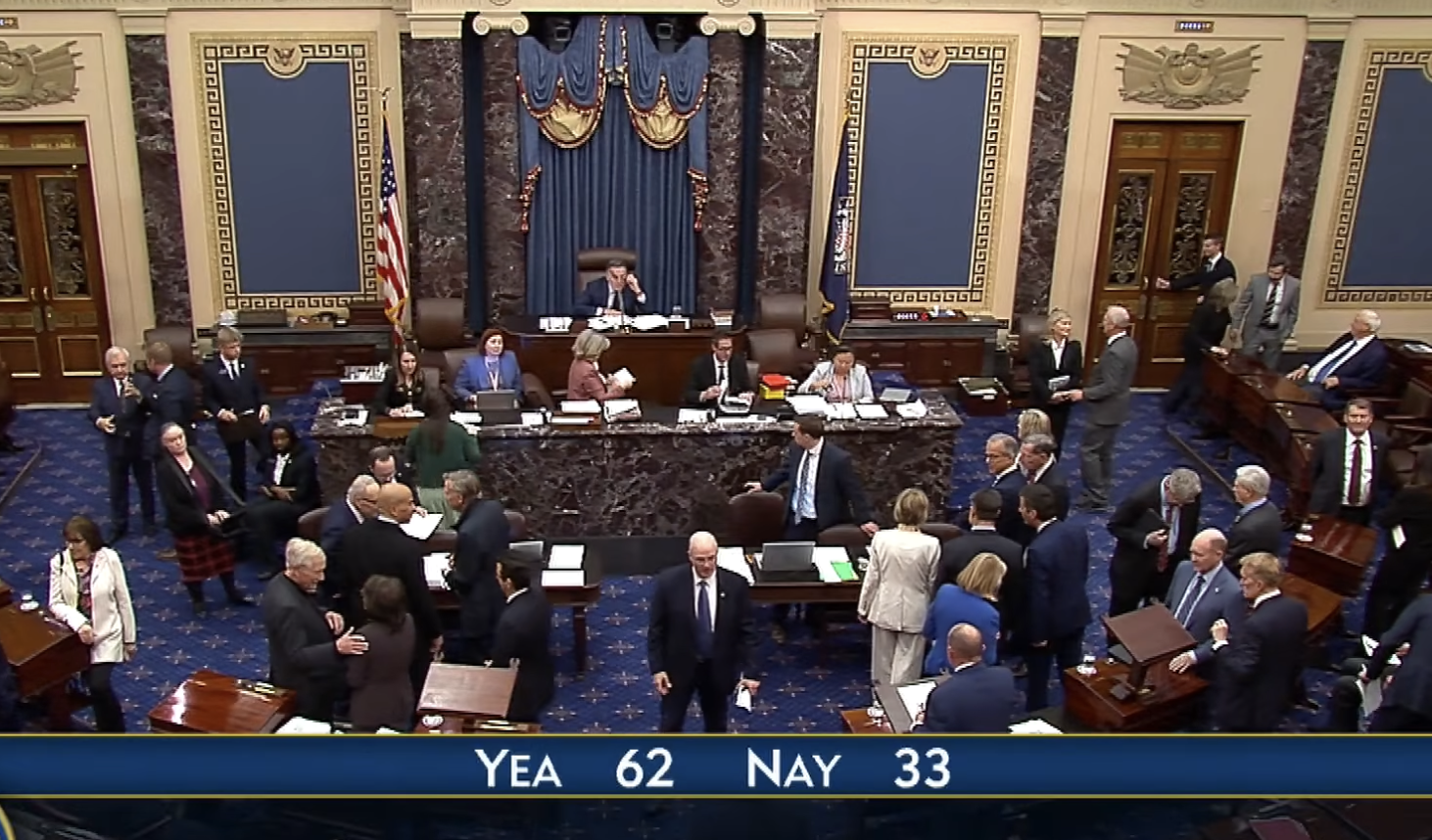
At a little after 10 pm Thursday night, the U.S. Senate passed legislation to strip bare bedrock environmental laws and accelerate the national artificial-intelligence data-center buildout. The bill known as BAAJA (the Bipartisan American Affordability and Jobs Act) passed by a vote of 62–33, after a standoff led to no amendments being considered.

In addition to federalizing transmission policy and establishing vast exemptions from the permitting process for industrial construction, highway energy, and mining projects, the bill effectively repeals the National Environmental Policy Act, Endangered Species Act, and National Historic Preservation Act, seriously weakens the Clean Water Act, and establishes project-certainty provisions that make halting illegal projects nearly impossible and protect built projects from future limitations.

The legislation enjoyed significant support from the current leadership of the Democratic caucus, including Minority Leader Chuck Schumer (D-N.Y.); co-sponsors Martin Heinrich (D-N.M.), the Energy and Natural Resources ranking member and Sheldon Whitehouse (D-R.I.), the Environment and Public Works ranking member; deputy whip and Indian Affairs ranking member Brian Schatz; and others such as John Hickenlooper (D-Colo.), Kirsten Gillibrand (D-N.Y.), and Ruben Gallego (D-Ariz.).

The bill now goes to the House, which resumes session after the Thanksgiving break.

Tags:

Ceres Board Member Gina McCarthy Opposes BAAJA

Posted by Brad Johnson on 11/19/2026 at 09:45PM

Gina McCarthy, the 13th U.S. EPA Administrator, former White House National Climate Advisor, and a current member of the climate-business advocacy organization Ceres, announced her opposition to the deregulatory BAAJA legislation on Wednesday, November 18th, as the Senate passed final cloture on the bill.

Her statement:

“If a bill has the full backing of President Trump and this White House, then that should give everyone pause. The bill may be a well-intended effort to advance clean energy to address our climate crisis and meet the health and safety needs of our people. But unfortunately, the bill as written would dismantle our country’s ability to enforce critical environmental laws. including the Clean Water Act, the Endangered Species Act, the National Environmental Policy Act, and the National Historic Preservation Act - while eliminating opportunities for environmental reviews, public participation, and input on issues critical to states, communities, families, and tribal nations all across our country. All of us who care about climate and clean energy must acknowledge the bill’s inadequacies and improve it before it becomes law.”

Ceres quickly announced organizational support for BAAJA a day after its release, well before any serious analysis of the legislation had been completed.

McCarthy is the second Ceres board member to publicly criticize the bill, following Sierra Club executive director Loren Blackford.

BAAJA Threatens Tens of Thousands of Federal Workers (Updated)

Posted by Brad Johnson on 11/17/2026 at 02:51PM

The positions of tens of thousands of federal employees will be under threat if the industrial-expediting bill BAAJA passes.

The civil servants involved in the federal review of industrial projects include archeologists, wildlife biologists, foresters, ecologists, botanists, hydrologists, geologists, environmental, civil, electrical, and nuclear engineers, environmental protection specialists, natural resources managers, community and urban planners, historians, Tribal relations specialists, and more.

Under the current Trump administration, about a quarter of the federal workforce involved in the federal permitting process has been lost; there are approximately 30,000 employees left. BAAJA could permit the administration to eliminate most of them.

BAAJA seriously weakens the Clean Water Act; effectively repeals the National Environmental Policy Act (NEPA), the Endangered Species Act, and the National Historic Preservation Act, and mandates an AI-run permitting system (eNEPA) for what’s left.

The Trump administration can be expected to rapidly commence the assignment and then reductions in force (RIFs) of federal employees involved in developing Environmental Impact Statements and ESA consultations, Clean Water Act permit reviewers and enforcement staff, cultural resource managers, DOJ NEPA litigators, and permitting coordinators.

Likely affected agencies include the Environmental Protection Agency, U.S. Army Corps of Engineers, Bureau of Land Management, U.S. Forest Service, U.S. Fish and Wildlife Service, National Oceanic and Atmospheric Administration, Department of Energy, Council on Environmental Quality, Federal Energy Regulatory Commission, the Department of Housing and Urban Development, Department of Transportation, Federal Emergency Management Agency, the Department of Energy, the Department of Defense, the Department of Justice, the Nuclear Regulatory Commission, as well as the Advisory Council on Historic Preservation, the Permitting Council, and other advisory councils.

Most of these federal employees are represented by federal unions including the American Federation of Government Employees (the primary EPA and FEMA union), the National Federation of Federal Employees (including the Forest Service Council and HUD units), and the National Treasury Employees Union NTEU (including EPA’s Chapter 280).

“We strongly oppose BAAJA,” AFGE Local 704 announced on X on Monday. “The current proposal favors industry interests over the needs of people in the six states we serve. It strikes at the foundations of the environmental policies that have kept our communities safe from corporations for more than 50 years.”

AFGE Local 704 represents 1000 EPA employees in six states across the Midwest.

On Tuesday, AFGE Council 238 President Justin Chen called BAAJA “a dangerous giveaway to corporate interests.” “Congress has no business dismantling decades of environmental safeguards just to fast-track data centers and fossil fuel production for wealthy corporations.”

His full statement:

“BAAJA is a dangerous giveaway to corporate interests that puts the health and safety of millions of Americans at risk. AFGE Council 238 calls on Congress to oppose this legislation, which threatens to gut critical protections under the Clean Water Act, the National Environmental Policy Act, and the Endangered Species Act. Congress has no business dismantling decades of environmental safeguards just to fast-track data centers and fossil fuel production for wealthy corporations. This was made clear in the mid-terms election results.

“Communities across the country are already bearing the consequences of toxic pollution and the worsening climate crisis. Stripping away these protections would only give corporate polluters more power while leaving families to pay the price, particularly those already disproportionately exposed to environmental hazards. The production of sustainable, green energy is a question of government resources and priorities rather than permitting red tape. Congress should not be fooled by the promises of bad corporate actors.

“No community should have to sacrifice its clean air, safe drinking water, or health to pad corporate profits. Congress must reject BAAJA and stand up for the communities whose health and futures are on the line.”

AFGE Council 238 represents about 8000 EPA employees.

The Progressive Workers Union, which began as the Sierra Club employees’ union and now represents over 500 non-profit employees, opposes BAAJA:

We believe that this bill could unleash the very data centers that are necessary for the AI models replacing workers across sectors, including public sector workers, healthcare workers, creative workers, and even teachers. Through its rollbacks of the National Environmental Protection Act (NEPA), BAAJA could also help accelerate the Trump administration’s buildout of deadly ICE detention centers.

The National Education Association, with three million members being the nation’s union, separately opposes BAAJA because it would unleash the construction of ICE detention centers.

The 225,000-member union Nurses National United joined AFGE 704 and other organizations in opposition to BAAJA as a data center power grab.

Updated Nov. 19 and 20 with union statements.

Tags:

DC Preservationist Warns BAAJA Will Take Away Washingtonians' Home

Posted by Brad Johnson on 11/13/2026 at 07:01PM

At the Capitol Hill rally opposing BAAJA on Monday, DC Preservation League president Rebecca Miller warned of the unique threat the bill’s effective repeal of the National Historic Preservation Act poses to Washingtonians.

Her organization is suing the Trump administration over its destructive plans for the Eisenhower Executive Office Building, Kennedy Center, and East Potomac Park.

As Washingtonians, we face a unique challenge. We're a hometown to nearly 700,000 residents, but federal agencies control much of our land, our buildings, and our public spaces. This is why we're gathered here today.

This is why section 106 of the National Historic Preservation Act is our frontline defense to manage change in our city. Section 106 isn’t just legal jargon or bureaucratic paperwork. It’s the people’s right, our right to stand up, speak out, and demand a seat at the table. It requires federal agencies to pause before building, altering, or demolishing. It tells them you cannot change our city in secret behind closed doors.

Washingtonians are still denied voting representation in Congress. And we currently have a president who treats our city’s historic resources as if they are his own personal portfolio.

Come January, this new Congress can, if it chooses, to put a check on this administration. We can return to a normalcy where section 106 isn’t perceived by the government as optional. It’s imperative. And agencies will once again need to pause and answer a fundamental question: Is there a better way to treat this historic site?

But if this permit reform bill moves forward and becomes law, the public loses its seat at the table. DCPL loses its seat at the table and we will have zero to say in the future of the federally owned historic sites, and you’ve heard much about them: East Potomac, West Potomac, Eisenhower Executive Office Building, Kennedy Center, Rock Creek Park, Union Station just over here. The list goes on and on, because the government owns more than 25% of our city. And so we will not have this opportunity to have any kind of input into it.

As of now, our DC state historic preservation office consults on between 350 and 500 federal undertakings every single year. And neither does the Historic Preservation Office, nor does DCPL, see preservation as a barrier to progress. We view it as a blueprint for our city’s future.

Our history is irreplaceable. Once a wrecking ball swings, a piece of Washington’s story is lost forever. We’re not just standing up for old buildings. We’re fighting for our history, our heritage, and our right to shape the historic and built environment of our city. So, let’s keep fighting for DC, for underrepresented communities, for our tribal friends and family, and for our heritage sites across America.

In a Facebook post on Thursday, November 12, the D.C. Preservation League called for Congress to oppose BAAJA, saying:

The BAAJA bill is bad for historic resources across our country. It strips the public, tribes and organizations like DCPL their seat at the table when deciding what happens to our historic resources across- that are owned by the public and funded by the public. Decisions will be made behind closed doors. For DC, Section 106 of the National Historic Preservation Act is our frontline defense to manage change in the federal city. Think East Potomac Park, Rock Creek, West Potomac, The Arch, Kennedy Center, Logan Circle…the list goes on and on.

Tags: ,

18 State Attorneys General Call For BAAJA To Be Dropped (Updated)

Posted by Brad Johnson on 11/12/2026 at 07:15PM

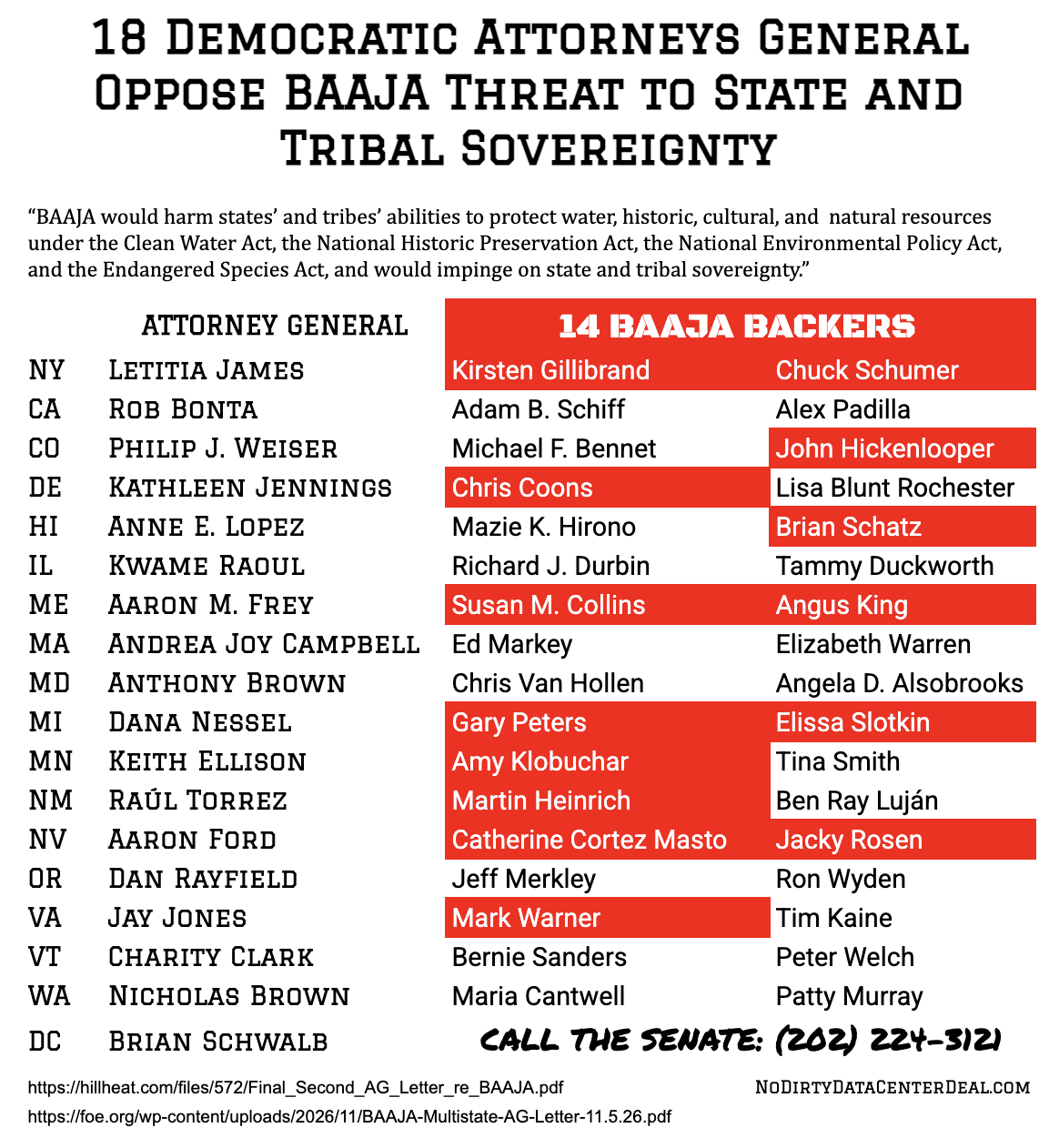
18 Democratic attorneys general, including two governors-elect, notified the U.S. Senate that they oppose BAAJA’s threat to state and tribal sovereignty, and do not want the legislation considered during the lame-duck session. They sent the letter in response to the Saturday release of the managers’ amendment and before the first vote to bring the legislation, now attached to H.R. 2347, to the floor. The bill, they warn, “provides federal agencies with nearly unfettered discretion to make key determinations with no input from states or tribes.”

“We ask that Senate leadership delay the upcoming vote,” the states’ top legal officers wrote, “to allow for continued discussion and stakeholder engagement to protect our natural resources, historic and tribal sites, and state regulatory prerogatives.”

The signatories are Attorneys General Letitia James (N.Y.), Rob Bonta (Calif.), Governor-elect Philip J. Weiser (Colo.), Kathleen Jennings (Del.), Kwame Raoul (Ill.), Anne E. Lopez (Hawaii), Aaron M. Frey (Maine), Andrea Joy Campbell (Mass.), Anthony Brown (Md.), Dana Nessel (Mich.), Keith Ellison (Minn.), Governor-elect Aaron Ford (Nev.), Dan Rayfield (Ore.), Jay Jones (Va.), Charity Clark (Vt.), Nicholas Brown (Wash.), and Brian Schwalb (D.C.)

They warned: “BAAJA would harm states’ and tribes’ abilities to protect water, historic, cultural, and natural resources under the Clean Water Act, the National Historic Preservation Act, the National Environmental Policy Act, and the Endangered Species Act, and would impinge on state and tribal sovereignty.”

This letter followed a November 6th letter from six AGs, led by New Mexico AG Raúl Torrez, warning that the bill “trades too many protections for speed.”

First, BAAJA gives federal officials broad discretion without safeguards for ethics, scientific integrity, or independence from the industries they regulate. Second, it weakens tribal consultation and permits agencies to unilaterally decide whether sacred places will be harmed. Third, it shortens and narrows environmental review and limits the remedies available when review is inadequate. Fourth, its permitting changes reach well beyond transmission, into mining, oil and gas, geothermal, hydropower, and offshore leasing. And finally, it gives project sponsors enforceable remedies while substantially limiting the ability of the public, states, and tribes to stop unlawful approvals.

Fourteen of the 73 senators who voted on Monday in favor of bringing BAAJA to the floor represent these 17 states. They are: Kirsten Gillibrand and Chuck Schumer (N.Y.), John Hickenlooper (Colo.), Christopher Coons (Del.), Brian Schatz (Hawaii), Susan Collins and Angus King, Jr. (Maine), Gary Peters and Elissa Slotkin (Mich.), Governor-elect Amy Klobuchar (Minn.), BAAJA co-sponsor Martin Heinrich (N.M.), Catherine Cortez Masto and Jacky Rosen (Nev.), and Mark Warner (Va.).

In addition to Klobuchar, Collins and Peters are leaving the U.S. Senate. Klobuchar plans to appoint her temporary successor before a special election; Collins and Peters will be succeeded in January by Abdul El-Sayed and Troy Jackson.

As Washington, D.C. is a federal district with much of its land under direct federal control, BAAJA poses a particular threat to A.G. Schwalb’s cases against Trump. Hill Heat has published the series BAAJA Follies on that threat.

Download the full November 9 letter and the full November 6 letter.

Tags:

Incoming Congressman: Passing BAAJA 'Would Be a Terrible Mistake'

Posted by Brad Johnson on 11/11/2026 at 04:22AM

In a New York Times interview, Will Lawrence, an incoming member of Congress elected to a rural district in Michigan on the strength of the data-center backlash, warned against the lame-duck Congress passing legislation designed to expedite the data-center buildout.

“I think it would be a terrible mistake after an election that was about corruption to pass this bill,” Lawrence told Times reporter Claire Brown about the industrial-expediting bill known as BAAJA, “which further empowers the wealthiest corporations in the country to run roughshod over local communities to build community-polluting projects.”

Lawrence further warned that the purported benefits for the renewable energy industry of fast-tracking projects with limited or no public review could spur an even greater political backlash against the transition away from fossil fuels.

“The data centers issue is poisoning the entire conversation around the energy transition in my district,” he said. “People see transmission lines feeding power to data centers, and if we don’t deal with the data centers, then there will continue to be extreme backlash against clean energy as well as transmission. And that’s what I’m seeing in my district.”

Lawrence, a co-founder of the youth climate activism organization Sunrise Movement, defeated Republican incumbent Rep. Tom Barrett in Michigan’s 7th District, which includes Lansing and its surrounding rural communities. Opposition to the imposition of data center projects in the district became his top issue, as they threatened the constituents’ land, water, air, and autonomy. He supports a federal moratorium on new data center construction until the existential risks that the AI companies themselves claim their products pose are properly regulated.

Transcript:

Tags:

Al Gore: BAAJA 'Would Be An Extremely Serious Mistake'

Posted by Brad Johnson on 11/10/2026 at 09:49PM

In a statement posted to Elon Musk’s X platform, former Vice President Al Gore called S. 5653 (BAAJA) “an extremely serious mistake” that “would do far harm than good.”

He continued that “now is not the time to give the Trump administration freer rein to double down on fossil fuels,” and concluded, “after last week’s historic election, we will have a new Congress in January that can strike a far better balance.”

His full statement:

I have tremendous respect for the two Democratic Senators who have negotiated the permitting bill with two of their Republican colleagues — a bill that Congress is considering for passage during the lame duck session. I sincerely and respectfully urge the Democratic sponsors of the bill to reconsider their decision to move forward with this legislation. There’s no doubt that we need to reform the way that clean energy projects are reviewed and permitted. But as it currently stands, the bill would be an extremely serious mistake, in my opinion, and would do far more harm than good. Given how this Administration has run roughshod over the environmental laws and protections that are currently in place, now is not the time to give the Trump administration freer rein to double down on fossil fuels — which is what President Trump would surely do. And after last week’s historic election, we will have a new Congress in January that can strike a far better balance.

Report: BAAJA Meets And Exceeds Project 2025 Goals

Posted by Brad Johnson on 11/06/2026 at 10:32PM

BAAJA (S. 5653), the industrial-expediting bill that is the lame-duck Congress’s top priority, meets and exceeds the goals of the Trump administration’s Project 2025 agenda, a new report finds.

In the report entitled “BAAJA’s path from a far-right think tank to Congress,” Friends of the Earth notes that the Heritage Foundation’s Project 2025 report’s section on the Council on Environmental Quality concludes:

"Finally, the President should work with Congress to establish a sweeping modernization of the entire permitting system across all departments and agencies that is aimed at reducing litigation risk and giving agencies the authority to establish programmatic, general, and provisional permits."

The authors wryly note that the permitting reform in BAAJA is “nothing if not ‘sweeping’. The bill guts NEPA, the CWA, and ESA, significantly restricts judicial review, and limits the ability of future administrations to amend or rescind permits for harmful projects.”

Citing the skyrocketing energy demand of data centers, in June the Heritage Foundation demanded “permitting reform” that effectively eliminates the National Environmental Policy Act, the Endangered Species Act, and Clean Water Act Section 401, and sets a 150-day limit on permit timelines. BAAJA includes all of those demands. Heritage has endorsed BAAJA.

Download the report.

Tags: